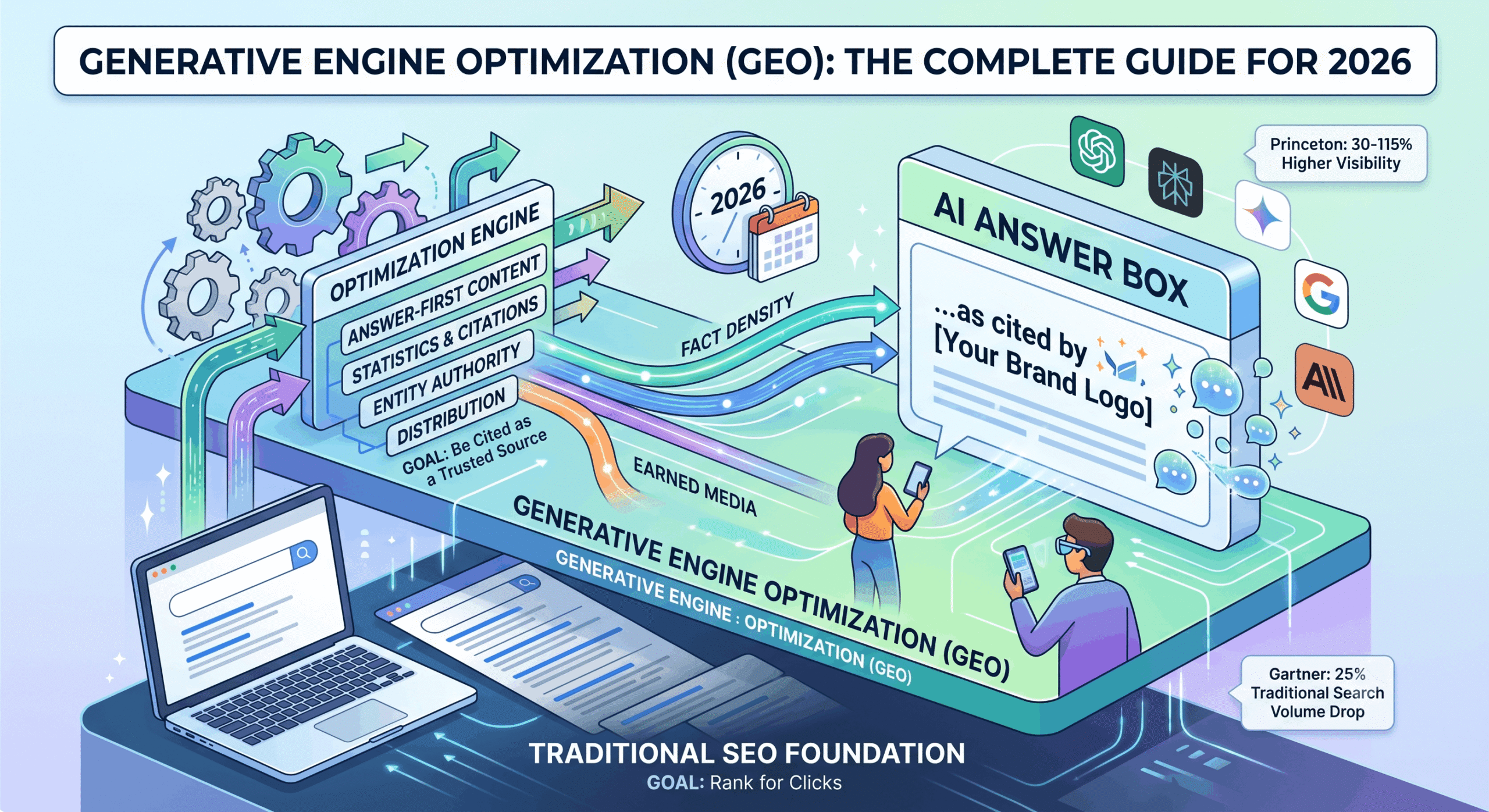
Generative Engine Optimization (GEO)
The Complete Guide for 2026
Search has changed. Not gradually, not quietly, but in a way that makes the SEO playbook from three years ago look like a relic. The goal used to be simple: rank on page one of Google, earn a click, drive traffic. That model still works, but it is no longer the only game in town, and for a growing portion of buyer journeys it is no longer even the first stop.
Today, a person with a question is just as likely to type it into ChatGPT, ask Perplexity for a comparison, or read a Google AI Overview before they ever scroll to a list of blue links. The companies that show up inside those AI-generated answers are capturing attention at the earliest and most influential stage of the decision process. The companies that do not show up there are increasingly invisible, regardless of how well their pages rank.
This is the problem that Generative Engine Optimization, or GEO, was built to solve.
What GEO Actually Is
Generative Engine Optimization is the process of structuring, writing, and publishing content so that AI language models, including ChatGPT, Perplexity, Google Gemini, Google AI Overviews, and Claude, cite it when answering user queries.
The distinction from traditional SEO is important. SEO optimizes for a ranking position in a list of results. GEO optimizes for being the source an AI quotes when a user asks a question. The output is different, the measurement is different, and several of the tactics are different, even though the underlying foundations of quality content and genuine authority overlap.
The term itself comes from academic research. A study from Princeton, Georgia Tech, and IIT Delhi found that GEO-optimized content achieves 30 to 115 percent higher visibility in AI-generated answers. That research introduced the term and established the core finding: how you structure and source your content has a measurable impact on whether AI systems choose to cite you.
Why This Matters Right Now
The scale of what is happening to search behavior in 2026 is difficult to overstate.
Gartner predicts traditional search engine volume will drop 25 percent by 2026, with AI chatbots and virtual agents capturing that share. Organic search traffic is predicted to decrease by 50 percent or more as consumers embrace generative AI-powered search. 58.5 percent of Google searches in the US already end without a click, rising to 75 percent on mobile. When AI Overviews are present, organic click-through rate drops by 61 percent.
Gartner projects AI assistants will handle roughly a quarter of global searches this year and more than half by 2028. AI-referred sessions jumped 527 percent year over year in the first five months of 2025, according to Previsible’s 2025 AI Traffic Report.
These are not speculative projections from vendors trying to sell new tools. They are directional signals from multiple independent sources pointing at the same structural shift. AI is becoming a layer through which a significant portion of search intent is being filtered, and that layer has its own rules about which sources it trusts.
GEO Is Not a Replacement for SEO
This point deserves to be stated clearly because the marketing around GEO often implies a clean break from the past. That framing is wrong and it leads marketers to make bad decisions.
GEO is not a replacement for SEO. It is an additional layer. Brands that excel at GEO in 2026 are typically the same brands with strong traditional SEO foundations. The optimization principles overlap significantly, but GEO adds specific requirements around content structure, citation-friendliness, and data richness that SEO alone does not address.
Google still owns 90 percent of search market share. The smartest approach is to treat GEO as a layer you build on top of a working SEO foundation, not a replacement for it. Ranking well in Google still increases the probability that AI systems, which pull from the open web, will find and cite your content in the first place.
How AI Engines Decide What to Cite
Understanding why AI systems choose one source over another is the foundation of effective GEO. Several research-backed patterns have emerged.
Traditional SEO tactics such as keyword stuffing have negligible or even negative effects on AI rankings. Instead, fact density, meaning the inclusion of authoritative citations, statistics, and quotations, can boost the visibility of lower-ranked websites by up to 40 percent in AI responses.
Adding statistics to content is the single most effective GEO tactic, improving AI visibility by 41 percent. Brand mentions correlate three times more strongly with AI visibility than backlinks. Distributing content to a wide range of publications increases AI citations by up to 325 percent compared to publishing only on your own site.
Peer-reviewed research from Princeton found that GEO techniques lift AI citations by up to 40 percent, with quotations, statistics, and inline citations producing the largest gains. Perplexity cites sources in 97 percent of its responses.
Different AI platforms also have meaningfully different source preferences. ChatGPT favors Wikipedia, which accounts for 47.9 percent of its top citations, while Perplexity prioritizes Reddit at 46.7 percent, requiring entirely different content and distribution strategies. A brand trying to show up in ChatGPT answers needs to think about entity authority and encyclopedic coverage. A brand trying to show up in Perplexity needs to think about community presence and discussion thread visibility.
84 percent of AI citations come from earned media, per a Muck Rack study of 25 million cited links across ChatGPT, Claude, and Gemini, making PR the strategic foundation of AI visibility.
The Tactics That Actually Work
Research and large-scale citation studies in 2026 have identified a clear set of practices that move the needle on AI citation rates.
Answer-first content structure. AI systems that use real-time retrieval, such as Perplexity and Google AI Overviews, evaluate a page’s relevance primarily on its opening content. The first 200 words of any article should directly and completely answer the primary query, not build up to the answer. This is a significant departure from the traditional SEO content formula that hooks the reader and delays the core answer.
Short, extractable paragraphs. AI engines pull self-contained blocks, not flowing narrative. Keep paragraphs short at two to three lines for extractability. Use comparison tables where applicable, as tables are among the most citable content formats.
Named statistics with sources. The Princeton research finding that statistics improve AI visibility by 41 percent is the most consistently replicated result in GEO research. Every claim that can be quantified should be quantified, and every statistic should name its source. This signals to AI systems that the content is grounded in verifiable fact rather than opinion.
Author credentials. Anonymous content or content team bylines are GEO penalties. AI systems increasingly weight author credentials. Bylines with linked author bios, professional credentials, and verifiable track records meaningfully improve citation probability, particularly for YMYL topics.
FAQ sections. The question and answer content format is valuable because AI engines extract Q and A blocks well. This is about content structure, not schema markup.
Original data and research. Publishing research that becomes a citation magnet, such as original surveys, benchmarks, and data studies, creates a compounding citation network that benefits every piece of content on a domain. Original data gives AI systems something they cannot synthesize from existing sources, which makes it disproportionately citable.
Distribution beyond your own site. The finding that distributing to a wide range of publications increases citations by up to 325 percent reflects a simple truth: AI systems draw from the broader web, not just your domain. Guest posts, PR placements, expert quotes in industry publications, and presence on platforms like Reddit and LinkedIn all expand the footprint from which AI systems can discover and cite your brand.
What Does Not Work Anymore
One of the more useful developments in GEO research in 2026 is the accumulation of evidence about tactics that do not work, which prevents agencies and brands from wasting effort.
Google’s official generative AI search guide published in May 2026 states plainly that structured data is not required for AI Overviews or AI Mode, and there is no special schema markup needed for them. The guide includes a section explicitly calling out tactics it considers unnecessary, including llms.txt files and content chunking.
An Ahrefs study in 2026 tracking 1,885 pages that added JSON-LD found no major citation uplift from schema alone. Schema remains useful as a hygiene measure and for Google to understand your entity, but it is not a lever for increasing AI citations. Investing heavily in schema optimization at the expense of content quality and distribution is a misallocation of resources.
Keyword stuffing, thin content, and link-building tactics designed purely for Google’s algorithm also produce poor results in AI citation environments, where the systems are evaluating content quality and authority at a semantic level rather than counting keyword frequency.
How to Measure GEO Performance
One of the genuine challenges of GEO is that traditional analytics tools were not built for it. Marketing teams must broaden their KPIs from just click-through rate to include citation rate, meaning the frequency with which a brand is used as a trusted source to construct an AI answer.
Practical measurement in 2026 involves several approaches. Manual citation tracking means regularly querying the AI platforms you care about with the questions your customers ask and recording whether your brand, content, or specific facts appear in the answers. GA4 referral tracking can surface traffic coming from AI platforms, which represents the subset of AI citations that result in a click. Dedicated AI visibility platforms such as LLM Pulse and Ansvisor offer automated tracking of citation rates across multiple AI engines, though the space is still maturing and results should be interpreted carefully.
Most teams see early movement within a few weeks of shipping answer-first, citation-dense content, with larger citation gains building over two to three months as engines re-crawl and entity authority accrues.
The Entity Layer: Being Understood, Not Just Indexed
One aspect of GEO that separates it most sharply from traditional SEO is the emphasis on entity authority. AI systems do not just crawl and index pages. They build a model of who and what exists in the world, and they decide how much to trust each entity based on signals that extend well beyond a single website.
AI systems are now aggregating everything the internet says about a brand, including product reviews, customer complaints, social media chatter, forum discussions, and PR coverage, then using that composite to decide whether a brand is worth recommending in their results. SEO cannot fix fundamental product or service problems. The brands that win build a stronger product and value proposition, doubling down on real expertise and evolving based on authentic customer feedback.
This means GEO is not purely a marketing or content function. It requires alignment between what a brand says about itself and what the broader web says about it. A brand with strong content but poor customer reviews or inconsistent online representation will underperform a competitor whose content is thinner but whose entity signal is cleaner and more consistent.
Where GEO Is Heading
With ChatGPT surpassing 800 million weekly active users, AI is not an emerging trend. It is now a structural layer of search behavior.
GEO turns AI discovery from an occasional outcome into a measurable operating process. The companies that consistently earn AI visibility will become the companies buyers remember first.
The practical implication for agencies and in-house SEO teams is clear. GEO is not a future consideration. The brands investing in it now are building citation share while competition is low. The brands waiting for the landscape to stabilize will find that AI citation patterns, like search rankings before them, are significantly harder to dislodge once they are established.
The fundamentals of good content, genuine expertise, consistent publishing, and real distribution have not changed. What has changed is the surface on which those fundamentals get rewarded. Build for that surface, and build now.